
How to Compare Two Lighting Quotes Without Getting Burned
How to Compare Two Lighting Quotes Without Getting Burned
Lighting Guide · Oct 23, 2026 · 4 min read
Two quotes for what looks like the same fixture can differ by 40%, and both can be honest. The gap
is almost never margin. It sits in five variables that buyers rarely normalise before comparing.
This is a method for putting two quotes on the same basis, and for reading what the cheaper one
leaves out.
Normalise the basis before you compare
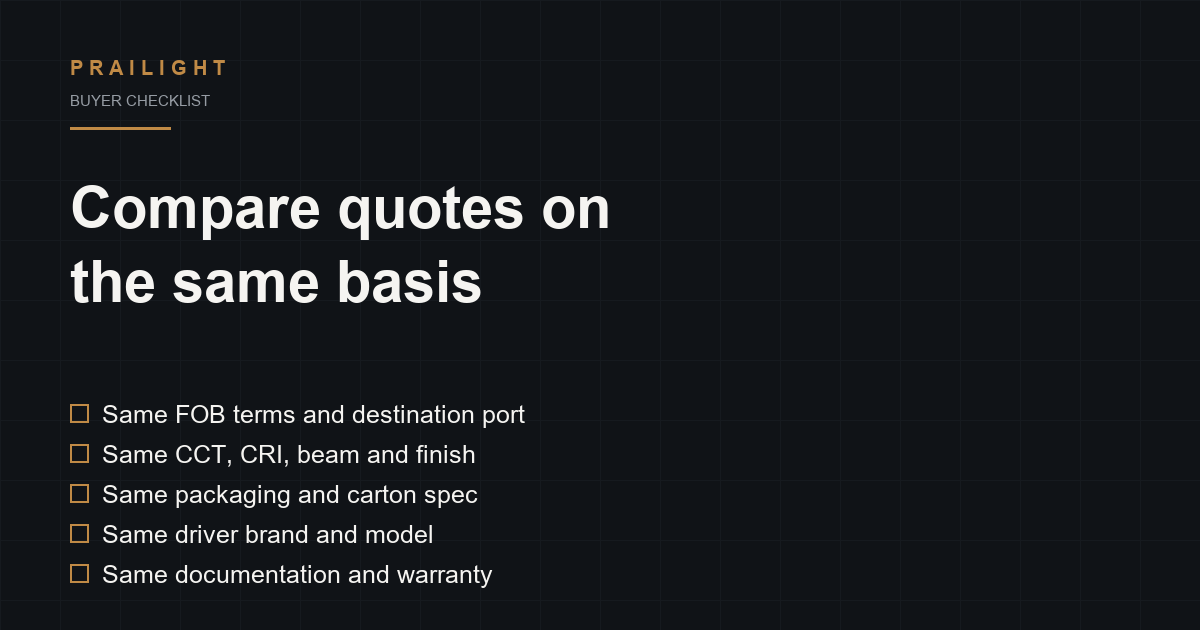
| Item | What “same basis” means |
|---|---|
| Trade term | Both FOB, same port, or both CIF to the same destination |
| Light output | Same CCT, CRI, beam angle and wattage — not just “24W” |
| Finish | Same substrate and coating, not “black” versus “matte black on steel” |
| Packaging | Same carton type and drop-test standard |
| Documentation | Same files promised: IES/LDT, LM-79 summary, driver datasheet |
| Warranty | Same term and same replacement mechanics |
If any row differs, you are comparing two products. Fix the basis first, then compare the number.
The five variables that explain a 20% gap
1. The driver
An unmarked constant-current driver and a branded one with a published lifetime can differ by 15% of
the fixture cost. The visible difference appears in year two, as a failure rate and as a replacement
part nobody can source. Ask for the driver model number in writing.
2. The finish
Spray paint on stamped steel and powder coating on die-cast aluminium are not the same process. In
coastal or humid markets the difference shows up as edge rust within two seasons, long after the
invoice is paid.
3. The packaging
Breakage in transit is charged back by your customer, not by the factory. A brown box without a drop
test can lose 3–8% of a container, which is more than the saving on the carton.
4. The documentation
A quote without IES/LDT files leaves your lighting designer guessing, and a guess becomes a change
order. Documentation is part of the product, not an extra.
5. The warranty mechanics
“Two years” means little without knowing what happens at month fourteen: replacement with the next
shipment, credit, or a return authorisation that never arrives. Ask for the sentence you would send a
customer.
What the cheaper quote usually hides
- A driver with no part number, so a failed unit cannot be repaired in the field.
- A thinner housing that changes the photometry and the glare rating.
- Cartons measured for a sample, not for a container.
- Certification “in progress”, with the test report promised after the deposit.
- A warranty that exists in the sales email but not in the order confirmation.
None of those are visible in a unit price. All of them land on the importer.
Documentation to demand before the deposit
- IES or LDT file for the exact configuration, not the family.
- LM-79 summary from an integrating sphere, not a calculated lumen figure.
- Driver datasheet with the model number and rated life.
- Packing drawing with carton dimensions, gross weight and drop-test standard.
- Certification status: what is held, what is applied for, and who pays for testing.
We hold CE, RoHS, IEC/EN and ISO 9001; listings we do not hold are applied for with your nominated
laboratory. The certification page sets out the scope rather than
implying more than we have.
A five-minute comparison method
- Rewrite both quotes into one table with the six rows above.
- Delete any line where the basis differs, and ask both suppliers to quote that line identically.
- Price the difference in documentation and warranty, not just the unit.
- Ask each supplier one question: what changes at 1,000 pieces?
The supplier who answers the fourth question with specifics is usually the one whose first quote was
already honest. For the products this usually applies to, see the
pendant range or how custom runs are quoted.
Frequently asked questions
Why is one quote 40% cheaper?
Usually a different driver, a cheaper substrate, thinner packaging and no documentation. Normalise those four before treating the gap as margin.
Should I always take the cheaper quote?
Only after the basis matches. A quote that is 20% cheaper with an unmarked driver is not cheaper, it is a different product with a different failure profile.
What should a quote include?
Trade term, CCT/CRI/beam, finish specification, driver model, packaging drawing, documentation list, warranty terms and lead time.
Related articles
MOQ for Custom Decorative Lighting: What Importers Should Ask
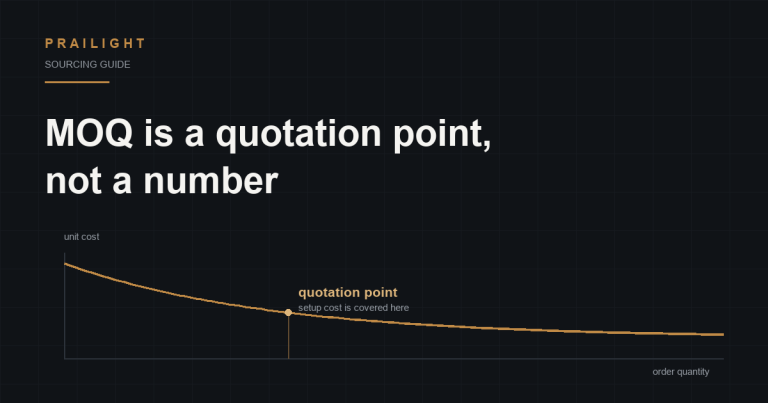
Why decorative lighting has no fixed MOQ, the five variables that move the quotation point, and the questions that get a usable answer from…
Read article
Why OEM Decorative Lighting Becomes Popular for Hotel Renovation Projects
Why OEM decorative lighting is winning hotel renovation briefs, and what importers should ask a factory before committing to a custom programme.
Read article
Decorative Wall Lights: Simple Fixtures That Transform Space Ambience
How decorative wall lights change room ambience at low cost — and which sconce formats sell best for distributors and projects.
Read article