
Key Factors to Consider When Sourcing Indoor Decorative Lights for Wholesale

Key Factors to Consider When Sourcing Indoor Decorative Lights for Wholesale
Sourcing · Oct 10, 2026 · 4 min read
Sourcing indoor decorative lights at wholesale volume is a different discipline from buying a sample. At 500 or 5,000 units, the things that decide your landed cost and your return rate are almost never the things shown in the product photos.
The five things that actually set your landed cost
Two quotes for the “same” fixture can differ by 40% and both be honest. The gap is usually here:
| Item | Cheap version | What it costs you later |
|---|---|---|
| Driver | Unmarked constant-current driver | 3–5% annual failure after year two; no replacement part number |
| Finish | Spray paint on stamped steel | Chalking and edge rust in coastal or humid markets |
| Packaging | Brown box, no drop test | 3–8% breakage in a 40HQ, charged back by your customer |
| Min order | Whatever they will accept | Half a container, freight per unit doubles |
| Documentation | Spec sheet only | Your lighting designer cannot sign off; project slips |
MOQ is not a number — it is a quotation point
Importers usually ask “what is your MOQ?” and expect a figure. For decorative lighting there is rarely one. Every model has a point at which the order is worth scheduling: tooling time, plating batch size, packing setup and QC all have a floor. A large pendant reaches that point at a lower unit count than a small sconce, because the unit value is higher.
Two practical consequences. First, ask for the quotation point per model, not for a company-wide MOQ. Second, ask whether models can be combined: mixed orders across a product line, and mixed containers across lines, usually bring each model’s effective quantity closer to its floor.
Documentation to demand before the deposit
- IES or LDT photometric files for the exact configuration you are buying
- LM-79 test summary (integrating sphere), not a marketing lumen figure
- Driver datasheet with model number and rated life
- Packing drawing with carton dimensions and gross weight
- Finish sample on the same substrate as production
If a supplier cannot produce these before the deposit, they will not produce them after it either. See how we handle test reports and certification scope.
CRI and CCT: what actually matters in hospitality
CRI 90 matters in lobbies, restaurants and retail because warm materials — wood, leather, skin — go grey under low-CRI light. CCT is a design decision, not a quality one: 2700K reads as residential, 3000K is the hotel default, 4000K belongs in back-of-house and offices. Mixing them across one floor is the most common specification error we see.
How to compare two quotes fairly
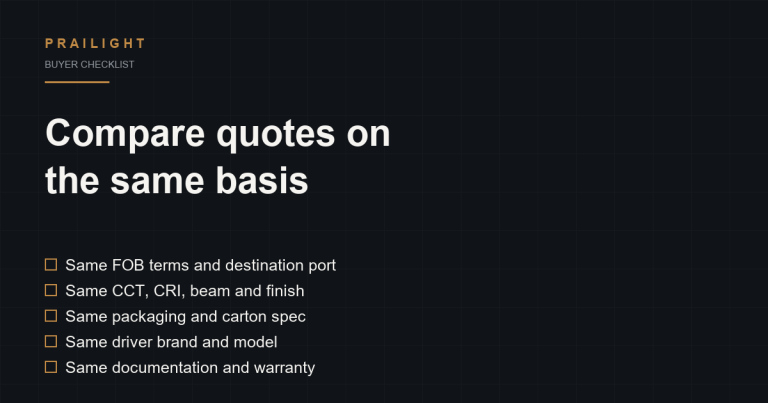
Put both on the same basis: FOB, same CCT and CRI, same finish, same packaging, same warranty. Then compare driver brand, IP rating and documentation. A quote that is 20% cheaper with an unmarked driver is not cheaper — it is a different product. Our ceiling range ships with the driver model printed inside the housing for exactly this reason.
Products mentioned in this guide
- Aurora Round Flush Mount — flush-mount LED ceiling light for hotel corridors and residential developments
- Orb Blown-Glass Pendant — hand-blown glass pendant for hospitality and retail interiors
Related reading
Frequently asked questions
Why is there no fixed MOQ?
Because the minimum is set by the quotation point of each model — the quantity at which tooling, plating and packing setup become viable. That point moves with the size and finish of the fixture, so a single company-wide number would be misleading.
Can I mix models in one order?
Yes. Mixed orders within a line and mixed containers across lines are both accepted, which usually brings each model closer to its quotation point.
What lead time should I plan for?
Samples from stock in 3–7 days; production 25–35 days after deposit and artwork approval. Add 30–38 days of sea freight to Santos, Jebel Ali or Ho Chi Minh City.
Related articles
How to Compare Two Lighting Quotes Without Getting Burned
Two quotes for the same fixture can differ 40% and both be honest. Normalise five variables before you compare, and know what the cheaper…
Read article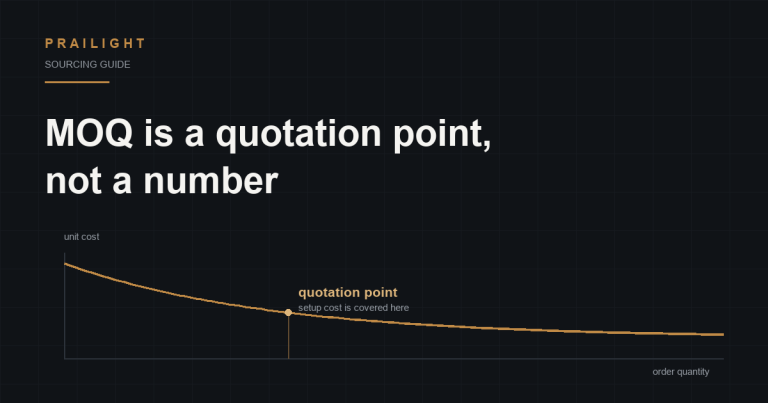
MOQ for Custom Decorative Lighting: What Importers Should Ask
Why decorative lighting has no fixed MOQ, the five variables that move the quotation point, and the questions that get a usable answer from…
Read article
Why OEM Decorative Lighting Becomes Popular for Hotel Renovation Projects
Why OEM decorative lighting is winning hotel renovation briefs, and what importers should ask a factory before committing to a custom programme.
Read article