MOQ for Custom Decorative Lighting: What Importers Should Ask
MOQ for Custom Decorative Lighting: What Importers Should Ask
Sourcing · Oct 23, 2026 · 5 min read
Almost every RFQ opens with the same line: what is your MOQ? On decorative lighting
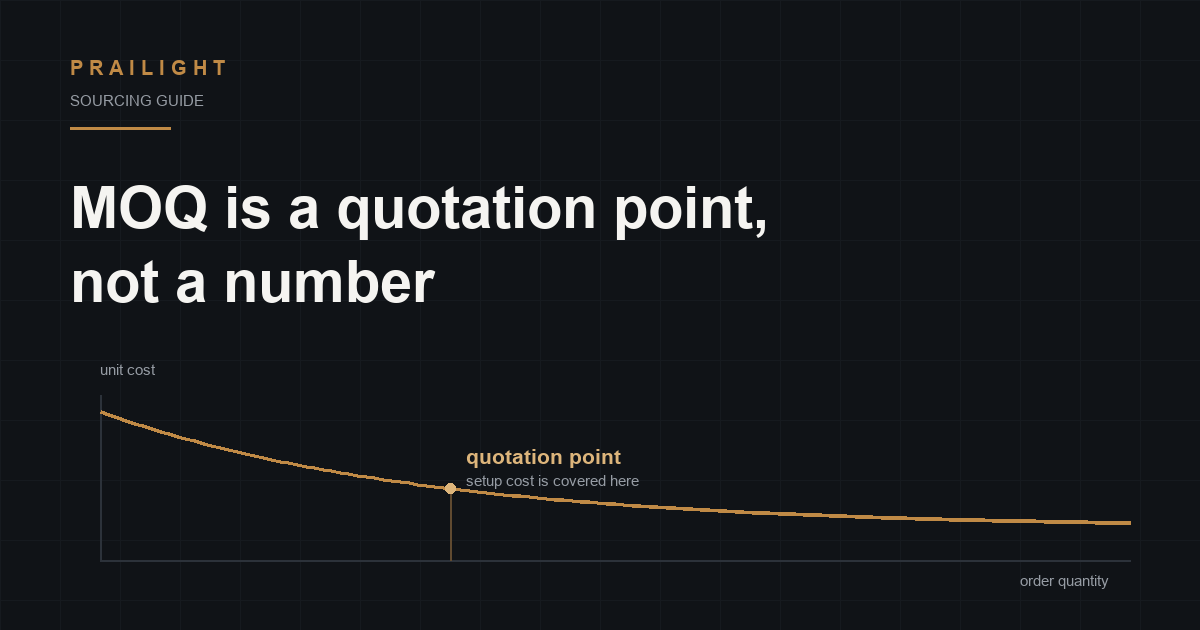
the honest answer is rarely a number. It is a threshold — the quantity at which a run becomes
worth scheduling — and it moves with the model, the finish, the driver and the packaging.
Buyers who understand what moves that threshold get useful answers. Buyers who treat MOQ as a
single figure end up comparing two quotes that were never comparable in the first place.
Why “MOQ: 100 pcs” tells you nothing
A factory schedules a run when the order covers its setup. Four costs sit in that setup:
- Tooling — a new mould is amortised across the order, an existing one is not.
- Surface finishing — powder coating and plating are batch processes. A custom
RAL colour means a batch change; stock black does not. - Packing setup — a retail box with your barcode needs artwork, a print run
and a line change. A brown box does not. - QC and testing — every batch is aged and lit before packing, which costs
bench time regardless of quantity.
A 600 mm pendant covers those costs at a lower unit count than a 120 mm sconce, because each unit
carries more value. That is why two models from the same factory can have very different minimums and
both be correct.
The five variables that move the quotation point
| Variable | What it does to the minimum | What to ask |
|---|---|---|
| Tooling | New mould raises it; an existing platform does not | Is this model tooled already? |
| Finish | Custom RAL or plating becomes a batch item | Is there a stock finish on the same body? |
| Driver | A nominated brand may have its own pack size | Which driver, and what is its pack quantity? |
| Packaging | Retail box adds print setup and a line change | Can the first order ship in a brown box? |
| Combination | Mixing models in one run spreads the setup | Can I combine models to reach the point? |
How mixed orders change the maths
Setup is per run, not per model. If three ceiling models share a finish and a carton size, one
production slot can cover all three. That is the practical reason a mixed order of 300 pieces across
four SKUs is often accepted when a single-model order of 300 would not be.
The same logic applies to freight. A container filled from two product lines spreads the fixed cost
of the sailing across more units, which changes the landed cost per piece as much as the ex-works
price does. If you are building a first order, ask for the loading plan before you assume a container
is out of reach.
What a credible answer sounds like
Weak: “Our MOQ is 100 pieces.”
Credible: “In stock black, this model reaches its quotation point at a low unit
count because the body is already tooled. In a RAL colour it becomes a batch item and the minimum goes
up. If you combine it with the 400 mm version in the same finish, both come down.”
The second answer tells you what you can actually buy. It also tells you the factory understands its
own cost structure, which is a decent proxy for how it will handle a change order later.
Four questions to put in your RFQ
- What is the quotation point for this model in a stock finish, and what is it in a custom finish?
- Which models can be combined in the same run or the same container?
- What is the pack quantity for the driver you are quoting?
- If we start in a brown box, what changes at the second order?
Answers to those four turn a vague number into a plan. They also expose factories that quote a
minimum without knowing why it exists.
Where buyers lose money on MOQ
- Ordering to hit a number rather than a need. Reaching a minimum with stock you
cannot sell costs more than paying a slightly higher unit price. - Splitting across too many SKUs. Every extra model adds setup and a carton spec.
- Ignoring the carton. A low unit price with inefficient packing can lose the
saving in freight. - Not asking about the second order. Setup costs fall once tooling exists, and the
minimum usually falls with them.
For how the same logic applies to private label, see the OEM process. If
you already have a model in mind, send it with a target quantity and we will confirm the quotation
point rather than quote a round number. Our FAQ covers lead times and sample
policy in the same detail.
Frequently asked questions
Can I order below the quotation point?
Not for production. You can buy a sample at prototype cost, or combine models in the same finish and packaging to reach the point together.
Does the minimum change on a repeat order?
Usually it falls. Tooling and packing artwork already exist, so the setup left to cover is the finishing batch and the bench time.
How do I compare MOQ between two suppliers?
Normalise by model, finish, packaging and driver first. A lower minimum in a stock finish is not comparable to a higher one in a custom colour.
Related articles
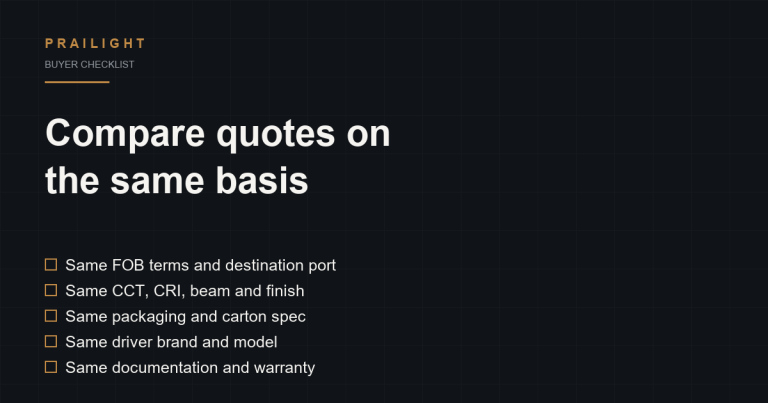
How to Compare Two Lighting Quotes Without Getting Burned
Two quotes for the same fixture can differ 40% and both be honest. Normalise five variables before you compare, and know what the cheaper…
Read article
Why OEM Decorative Lighting Becomes Popular for Hotel Renovation Projects
Why OEM decorative lighting is winning hotel renovation briefs, and what importers should ask a factory before committing to a custom programme.
Read article
Decorative Wall Lights: Simple Fixtures That Transform Space Ambience
How decorative wall lights change room ambience at low cost — and which sconce formats sell best for distributors and projects.
Read article