How Custom Decorative Lighting Elevates Commercial Interior Projects
How Custom Decorative Lighting Elevates Commercial Interior Projects
Manufacturing · Sep 17, 2026 · 3 min read
“Custom” is the most overused word in lighting supply. It can mean a different colour, a different drop length, or an entirely new housing. Those are four different projects with four different costs, and confusing them is how budgets slip.
The four levels of custom
| Level | What changes | Tooling | Typical lead time |
|---|---|---|---|
| 1. Configuration | CCT, wattage, beam, cable length | None | Standard |
| 2. Finish & branding | RAL colour, logo, packaging | None, but batch minimum | +1–2 weeks |
| 3. Adaptation | Modified housing, new diffuser, different driver position | Modified jig | +3–5 weeks |
| 4. New design | New mould, new optics | Full tool | 8–12 weeks |
Most commercial projects need level 1 or 2 and are quoted as if they need level 4. Ask which level a quote is priced at.
Where custom actually pays back
Not in the fixture cost — custom is always more expensive per unit. It pays back in three places: matching a design language that cannot be bought off the shelf, avoiding a redesign fee from the lighting designer, and owning tooling that a competitor cannot buy. If none of those apply, buy standard.
What the factory needs from you
A brief that can be manufactured contains five things: a dimensioned drawing or reference photographs, the target retail or project price, the destination market, the installation environment, and the quantity expectation. Missing the target price is the most common gap — without it, engineering optimises for the wrong cost.
Photometrics before commitment
Custom housings change the optics. A new diffuser or a deeper recess moves the beam and the glare rating, which is why IES/LDT files are produced for the prototype, not for the catalogue equivalent. Approve the photometry before the tooling, not after.
Common failure modes
- Approving a sample photographed under showroom light instead of measuring it
- Leaving the IP rating to “we will make it IP65” without a test report
- Skipping the pilot run to save two weeks, then finding the issue at 5,000 units
- No written tooling ownership
See the OEM/ODM process, the pendant range for typical adaptations, or send a brief for a quote within 48 hours.
Products mentioned in this guide
- Orb Blown-Glass Pendant — hand-blown glass pendant for hospitality and retail interiors
- Cylinder Up-Down Sconce — up-down wall sconce for corridors, facades and stairwells
Related reading
Frequently asked questions
What counts as custom?
Four levels: configuration (CCT, wattage, cable), finish and branding, adaptation of an existing housing, and a new design with new tooling. They differ in cost and lead time by a factor of five.
Do I need a new mould?
Only at level 4. Most projects are solved by configuration or a modified housing, which avoids tooling cost and shortens the timeline.
What should I include in a brief?
A dimensioned drawing or reference photos, target price, destination market, installation environment and expected quantity.
Related articles
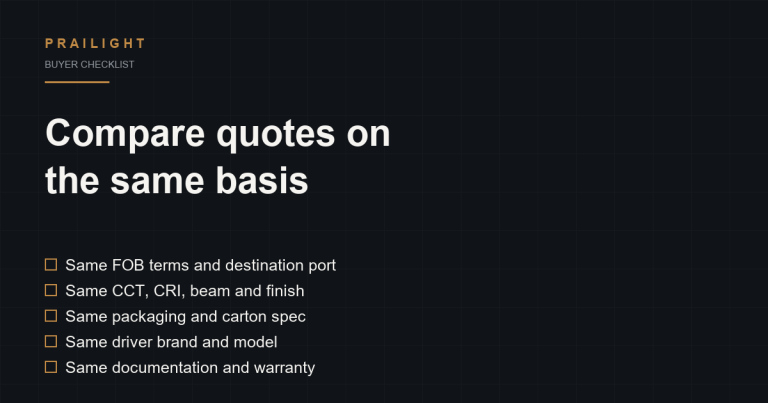
How to Compare Two Lighting Quotes Without Getting Burned
Two quotes for the same fixture can differ 40% and both be honest. Normalise five variables before you compare, and know what the cheaper…
Read article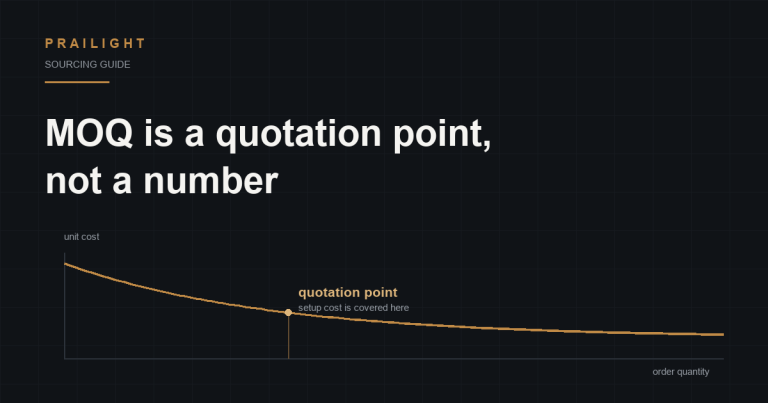
MOQ for Custom Decorative Lighting: What Importers Should Ask
Why decorative lighting has no fixed MOQ, the five variables that move the quotation point, and the questions that get a usable answer from…
Read article
Why OEM Decorative Lighting Becomes Popular for Hotel Renovation Projects
Why OEM decorative lighting is winning hotel renovation briefs, and what importers should ask a factory before committing to a custom programme.
Read article